Friday, August 25, 2017

What Can I Say????

It's been a busy summer. Not very clear either, at least at night. On the few nights I have had so far, I've concentrated on Messier objects, mainly globular clusters. Since they are “just stars”, meaning no nebulosity (well one is a nebula), mostly I imaged only in the luminance channel. Saturn and Jupiter were visible, so I imaged them on a few nights. I even got a couple of craters on the moon to almost complete imaging the Astronomical League's Lunar List. I also was able to get another look at NGC6946, the galaxy with the nova. Last, but not least, I attended the total solar eclipse, but didn't do any imaging. Fortunately, a good friend, Max Armstrong, did get a few good pictures, which he has agreed to allow me to post. Because of being such a busy summer, I think I will just post and identify the images, with little comment. There is a total of 23 of them. Group by date sound good? (It may take a couple of days to get everything uploaded.)

July 11. High cloudiness which shows up in the images. Images are of Jupiter and Io (moon), and two globular clusters M80 and M107. M80 is located in the constellation of Ophiuchus, M107 is in Scorpius.

Jupiter and Io just above the center line, to the right of Jupiter

M80, a globular cluster in Ophiuchus


M107 in Scorpius. The light scattering off the clouds is evident in the lower half of the image.


July 22. These are globular clusters and open clusters. It will probably be obvious which is which, just by looking at the density of stars in the image. All are located in the same general area, around Scorpius and Ophiuchus. 
 
M62 globular cluster in Ophiuchus


M6 open cluster in Scorpius


M7 open cluster in Scorpius


M10 globular cluster in Ophiuchus


M12 globular cluster in Ophiuchus


M14 globular cluster in Ophiuchus


M19 globular cluster in Ophiuchus
 Is it any wonder I call this "globular cluster season?"

Tuesday, June 13, 2017

Cloudy With A Chance Of....

Being able to see the sky. The past month has seen many changes at Starlight, including possible surgery in the near future. Hopefully not, however. Never the less, it's been incredibly cloudy, especially at night. Fortunately, there is a solar scope available. One thing I have wanted to do, but not been able to, is check on the supernova. Maybe soon.

So, what do I have.

Jupiter


Jupiter, of course. This image from May 31st using a 3x Barlow lens. Compared to standard F10, more detail is visible, so I'm generally pleased with the image. Seeing is still poor, but considering that, I think it's about as good an image as I could get.


The sun, of course. Image was taken on May 26th and shows a single prominance.


Also the sun, but taken June 13th. Notice the proliferation of prominances. Looks like solar activity has picked up a little, considering we are near solar minimum.


Monday, May 15, 2017

My First Supernova and a Comet

Just to be clear, I DID NOT find the supernova; it is, however, the first one I have imaged. Since I plan to spend a lot of time on it, let's start with the comet.

Comet C/2015 V2 Johnson
This is Comet C/2015 V2 Johnson. You might notice that it looks like a big fuzzy glowing ball. Well, that's right; that's the way comets look, for the most part. For some reason, possibly imaging too early in the night, it was difficult to image the tail. It may also have to do with the movement of the comet. Or maybe the tail is just very diffuse and hard to make out. This is a stack of just 2 images, each 3 minutes long. But, if you look very closely, it appears the nucleus (head) of the comet is slightly elongated, whereas the stars are not. That implies movement of the comet during the 6 minutes total time of the exposure. If you try hard, you can see the beginnings of the tail, going down and to the left (about a 45 degree angle) from the nucleus. However, when processing the image, the glow from the tail quickly faded into the background glow from the sky; so, it doesn't show up well here. I may try again, but using a more difficult technique; that being to try to track the comet and not the stars. That will be a real challenge for my mount.

On the night of May 13th, Utah amateur Patrick Wiggins discovered a possible bright supernova in the spiral galaxy NGC6946 in Cygnus. If confirmed, it will become the 10th supernova found in this explosion-rich galaxy in the past century. The nickname for this galaxy is the Fireworks Galaxy, so it appears to be living up to that name.

To have some fun with this, I'm going to use some of my images to show the supernova and give some idea of the degree of difficulty in finding one, other than the aspect of just being lucky to have the scope on the right galaxy on the right night.

Let's start with an image of NGC6946 I took on the night of October 10, 2015

NGC6946 in Cygnus
I referred to it as a spider on this blog at the time. At least that's what I thought it looked like. (Kinda still do, for that matter.) There are a couple of things to note, here; 1) there are a lot of stars in this image, and 2) even though there is some mottling of the galaxy (mostly from the dust lanes), it is mostly just a glow with no individual stars visible from the galaxy. What does that say about the stars visible? They are called foreground stars, meaning they are between us and the galaxy NGC6946, and are actually in our own galaxy, the Milky Way galaxy. They are in no way associated with NGC6946.

So, where was the supernova found? See below, which is a “marked up” version of the above image, with the arrow showing where supernova is.
Same image as above, but in black and white, showing where supernova will be found


Well, now for the money picture, the one we've all been waiting for. Mind you, this is a black and white only image.

NGC6946 with supernova taken May 14, 2017
Having trouble seeing it? This next image has a arrow pointing directly to it.

Oh, THERE it is!
Run back up to the first image of the galaxy and you'll see the "star" isn't there!
 
Finally, I thought it might be fun to see how it's brightness compares to that of the galaxy. Below is the above image, but with the foreground stars (mostly) digitally removed. The supernova is at least as bright as the nucleus of NGC6946, wouldn't you say? It's possibly as bright as the entire galaxy. But that's just the way it is with supernovas.

Same image as above but without those pesky foreground stars
It's a lot easier to spot on this image, ya think? And while you've got the brain working, remember that this thing went off at least 10 million years ago. We're just now finding out about it!

Sunday, May 7, 2017

Galaxies, A Lake, and A Fist

This entry starts with a galaxy in the Canes Venatici, the Hunting Dogs.

M106

This is M106, and friends. It was discovered in 1781 by Pierre Mechain and is about 22 to 25 million light years from earth. One interesting aspect of this galaxy is that it has a water vapor megamaser, which is the equivalent of a laser operating at microwave frequencies instead of at light frequencies and on a galactic scale. According to Wikipedia, this maser enabled the first case of a direct measurement of the distance to a galaxy. Also easily seen in this image are two other galaxies, NGC4231 and NGC4232, the two dim fuzzies near the left edge of the image and NGC 4248 the fuzzy line in between M106 and the other two galaxies. NOT easily seen in this image is another galaxy UGC7356 above M106 and a quasar, 1214+474, to the upper left. They show up as tiny dots, basically, when the image is very heavily processed. So why is that a big deal? (to me, anyway) Well, this is only a one minute image, taken with a small telescope in a moderately light polluted sky. If this were an image from a professional observatory, it would be nothing much at all.

M106 and friends identified, from Astrometry.net


A few nights before I imaged M106, I took a few images of the moon. The air was not terribly steady, but I did image Lacus Mortus, the Lake of Death. It appears to be a lava filled crater where the sides look to form and incomplete hexagon. Near the center of the Lake is the Crater Burg, which is about 24 miles in diameter. Maybe that will give a sense of scale to the image.

Lacus Mortus, just left and above ceenter


The last image is of 3 craters, (top to bottom) Theophilus, Cyrillus, and Catharina. These would be south of Lacus Mortus by a good distance. What struck me was the fist shape of the central mountain in Theophilus (not pun intended..... well, maybe :). To me, I see 3 fingers and a thumb. What about you?

Do you see a fist?(Large crater near top and just right of center)

Thursday, April 27, 2017

Galaxy Season

And apparently more clouds and rain as well. After what seems like a very long time away from the scope, I was able to get out on the night of April 25th and 26th . The 25th was by far the better night, and one of the few really good nights we get in Georgia. It was just luck, I suppose, that I was out then. In any event, I was able to get 2 images that I generally like. They are relatively close to each other in the sky, in Coma Berenices. I'll start with the image I took first.

M53


This is the globular cluster M53. It was taken first because I knew I would take the image using only the luminance filter and also while the sky wasn't completely dark; just mostly so. M53 is about 58,000 light years away. According to the web site Messier-Objects.com, the cluster contains about 500,000 stars and is moving towards us at 112Km/s (about 250,500 MPH). It has an estimated age of about 12.6 Billion years old.

A little later, I moved over the galaxy M64.

M64


I find this to be a very interesting galaxy. Notice the dark lane next to the nucleus. I suppose it's this feature that gives this galaxy the name of The Black Eye Galaxy, the Evil Eye Galaxy, or the Sleeping Beauty Galaxy (where did that come from?), take your choice. Different sources give different distances to the galaxy, but are generally in the range of about 20 million light years. The galaxy also has two disks of material that are rotating opposite of one another; ie one rotating clockwise, the other counter clockwise. One of the disks is the inner disk, the other the outer disk, with the dark area generally being seen as the area of separation between the two.

Galaxy showing dark lane near nucleus.
 Here's just the galaxy portion of the above image, processed a little differently to show better the "dark lane". That would be the dark area just below the bright dot that is the center of the galaxy.

Finally, our old friend Jupiter.


Unfortunately, this image was taken the night of the 26th and the air was particularly unsteady. This was just before a storm front moving in that night, so I guess I'm glad I got it as good as I did.

Monday, April 10, 2017

It's a Bird, It's a Plane, It's....

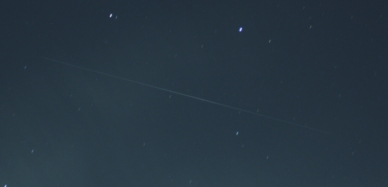
an indication you are at least as old as I am, if you know what comes next. However, in this case, it's a couple of images of one of the things I usually try to avoid imaging: a satellite. Specifically, an Iridium satellite. Even more specifically, and Iridium flare. What that is, is when the solar panels align with the sun, the satellite, and the person to cause and intense, short term brightening.

Iridium flare


This image is a 15 second exposure and shows most of the flare. You can see it starts fairly dim at the left side of the image, and over a few seconds, becomes very bright, and then start to dim again. Unfortunately, the exposure ended before the satellite returned to its original brightness. By the way, the star basically above where the trail of the satellite ends (and the brightest star on the right side of the image), is Regulus in the constellation of Leo, the Lion. Of course, this is a time lapse image, but visually, you see the satellite moving, in this case from left to right, and suddenly growing bright enough to the be brightest moving object in the sky, and then dim again, all in about 30 seconds. It's really kinda cool.

It should be noted that this is only a small portion of the entire image. The full image is below.

The big picture

This is a fairly large portion of the sky. The flare looks much small, huh? Almost directly below the flare,  but just out of the frame is what appears to be a bright light. Actually, it is. It's the moon.

Flare occurred about as far above the moon as the moon is above the trees.
This image shows the scale of the previous image, meaning in this case, just how much of the sky the camera saw. At least, you get some idea.


Just the moon from the image above.


This shows just how well a DSLR with a stock zoom lens, set to wide field, can capture the moon. Basically, this is what a “normal” DSLR would see. So, if you have one, and would like to know how well you might be able to take a picture of the moon, this is it. The image has been resized to 2x in “post processing”, meaning the imaged adjusting software I use, which is a very old version of Paint Shop Pro. The Mare are clearly visible. The camera was mounted on a tripod and a remote shutter release used to help minimize any camera shaking.

I was a little disappointed that I didn't capture the entire flare, so the next night, April 8th, I went out to get another flare. However, there were a fair number of clouds. Even though this was a much dimmer flare, I think it still looked pretty with the clouds and moon just out of frame.

Iridium flare just below center of the picture, behind some clouds.

And here is just the flare part where you can see the satellite going from dim to bright back to dim.

Dimmer flare, but shows the entire flare


Finally, on the night of the first flare images, April 7th, I took a few “through the telescope” images of the moon. One of the things I have been trying to do is get at least one image of each of the objects on the Astronomical League's Lunar List. Even though I already had an image of the crater Billy, I thought this was a better one.


Crater Billy


Obviously, this is the crater. But notice the crater floor; it's a dark gray and appears smooth. What's different? From my reading, the crater is considered an impact crater meaning, of course, something hit the moon and left a crater. But then the crater was flooded with lava, leaving the smooth and dark appearance. Looking at other craters, you will almost always see a central peak. That peak is the result of the impact. That Billy has no central peak implies that the lava flowed into it after the impact.

Monday, April 3, 2017

A Sunny Disposition

Images taken on April 2, 2017 near the Starlight Observatory.

This is the beginning of a venture into something I haven't done in years, and certainly not on my own. I now own a H-alpha, or hydrogen alpha, telescope that is used to look at the sun, and only the sun. Among other things, this will let me observe the sun in a way I haven't done from the observatory. The scope allows only light in the H-alpha band to come through to the eyepiece. The H-alpha band is around 656.6nm. Light at that wavelength is very red, hence the red images. Well, mostly red. Actually, the exposure allows the color to change to white because the image is overexposed, either slightly or a lot depending on which image we are looking at. However, if you looked through the eyepiece, the sun looks very red.

As a side note, the “red layer” of the sun is known as the chromosphere. The chromosphere is “outside” , or nearer to us, than the part of the sun we “normally” see. What we usually see is the yellowish photosphere. The chromosphere is, as I understand it, basically hydrogen that has been heated by the underlying layers of the sun enough to cause the electron to move to a different energy shell. When the electron drops back down to it's lower energy state, it emits a photon of light at the 656nm wavelength. While sunspots are visible in both the chromosphere and the photosphere, prominences are visible only in the chromosphere.


Surface of the sun showing features


As you can see in this image, we have three feature: sunspots, some of which I have pointed out, plage, which is an intense brightening on the surface caused by a mechanism similar to the mechanism that causes sunspots, and, right on the very edge of the sun, 3 prominences. The prominences are quite dim in this image, hence not really very “prominent” because of the exposure needed to see the other features.


Above is the same image, but with out the markings. Perhaps you can see a little more detail.

Same image as above, showing prominences. Longer exposure makes surface look white.

 
Last, but not least, is the overexposed, for the surface detail that is, image which shows more clearly the prominences. It's difficult to tell, but it appears that the uppermost prominences may be part of an arch. In the full resolution image, there appears to be a faint wisp of red directed towards the middle prominence.