
Monday, February 6, 2023
I Guess This One Should Start “Where Have I Been?"
It's been almost a year since the last entry, and, like the last entry, a lot has happened. Details are boring, but I have thought about making blog entries. Google Analytics shows the blog has been viewed about 1400 times, which is very much more than I thought it had been seen. When I log in, it looks like there have been almost no viewings for the last year. I figured, if no one is looking, why write. Apparently, somebody may have happened upon it a few times. However, in my defense, we haven't been home for months, being in Virginia helping our daughter and family. So, not much astronomy has been done.
However, today, while still in Virginia, I imaged the sun and captured one of the longest filaments I have seen.
 By my crude calculations, the long filament (the dark line roughly in the middle of the image), if drawn out, would stretch from the earth to the moon....and back to the earth....and then about ¼ the way back to the moon. To refresh your memory, a filament is a prominence, but viewed from directly above. (Prominences are seen on the edge of the sun and can look like a wave of plasma coming off the sun. There is a small prominence in this image about the 8 o'clock area.) Solar Cycle 25 is really coming alive.!

Saturday, May 14, 2022
Much Has Happened, Little Has Been Written
Last entry was mid January, it's now mid May. Looking back over the months, I've been able to image about 14 times on deep sky objects and, oh, several times on the moon. Some was experimentation, the rest, as usual, to see if I can get a decent image. All imaging has been with the Stellarvue; the Meade remains “forked”. For now, I can't see a huge reason to change from just the Stellarvue. For imaging on the moon, I can get at least as clear images (possibly better) and have a little more flexibility in that the field of view that matches the Meade is achieved by using a 3x Barlow lens. Remove the Barlow and I have another, generally good clear, focal length/field of view. And the transition takes less than 30 seconds.
It's been interesting learning a new mount and telescope. Skies are generally worse, being closer to a Bortle 5 or 6 rather than a 4 or 5. The light pollution really shows up in the images. However, one important lesson learned is that I need lots of flats and darks (calibration frames). By lots, I mean at least 45 each. I've also added another (as yet unused) filter, a 12nm wide Hydrogen Alpha. Shooting flats with it requires about a 5 second subframe (compared to subframes measured in tenths of a second for the other 4 filters). Shooting the flats (and flat darks) takes about 2 hours now compared to 15 minutes at the observatory. That said, I've worked out a method of shooting them inside instead of on the mount. I can set up the sequence in NINA and leave it to run unattended.
I guess by now you might want to see what I've got. So...
 |
| Good guess, it's the moon. However, it's a mosaic of 10 images in the original, so zooming in reveals a lot of detail. Not so much here, since I had to reduce the size from 400Mb to something much less. Sorry. |
 |
| This gives an idea of the level of zooming available in the image above, and this is down sampled by a factor of about 10. It's tilted so that it, sort of, aligns with the moon as seen from earth without a telescope. The area is of Sinus Iridium. |
 |
| M37. Light pollution gives it a color cast (greenish) that I haven't been able to remove. But... |
 |
| NGC2175. This is an emission nebula that would be perfect for the H alpha filter. Still, it's not too bad. For a beginner, that is. |
Wednesday, January 12, 2022
New Beginnings
Well, here's something I didn't expect to do: a new blog entry. Last entry was, I think, in April of 2021. Since then, MUCH has changed. We're at a new address, the old Meade LX200GPS is in semi-retirement (but soon to be reactivated), and a new telescope/mount has made it into service. The new mount is a Losmandy GM811 and the new scope is a Stellarvue SVX102T. So a 4” refractor vs. an 8” SCT. One of the main motivators for the change was the change in address; we are now in a continuing care facility. I no longer have the observatory, so I have to carry out the scope every time I want to use it. I can break the 811 into “chunks” of about 20 lbs. max to take out and set up vs. about 45 lbs. for the Meade. Hopefully, I will soon de-fork the Meade and put it on the 811. The 8” is still really good for the moon and planets. Plus, Meade is no longer, meaning that it went bankrupt and was bought by Orion Telescope. As such, the consensus is that the scopes are poorly supported now, if at all. If something breaks, there is little hope of repair.
So, last night (January 11, 2022), I was finally able to get the scope out and get most things working. Since this was mostly a test run, I didn't bother to cool the camera. Nevertheless, I was able to capture an image, this time of M42, the Great Orion Nebula, as well as the Running Man Nebula, all in the same image. I didn't do much processing, since there wasn't much to do; only stacking and stretching the image. The image is 10, 1 minute images of each color band, LRGB, so 40 minutes total. I'm pleased with the first light. It's not perfect, but pretty good for a 1st attempt with the new gear.
 |
| M42 and Running Man Nebula (top right). First light image. |
Monday, April 19, 2021
An Interesting and Difficult Galaxy Plus an Interesting Process
Let's start with the galaxy, which happens to be NGC4395 in the constellation of Canes Venatici. It's a very dim galaxy and in many ways the most difficult object I've had yet to process. It appears to be relatively nearby at around 14 million light years away, but has a low surface brightness. To me, that low surface brightness is interesting because is appears, by color, to be very active with blue stars. Blue stars are among the hottest stars and usually are bright. Rigel, in the constellation of Orion is a hot, blue star which is very bright. Because of the low surface brightness, and because of the blue being in the less responsive region of the camera, sort of a double whammy, even a couple of hours of light collection yielded a dim galaxy. Of course, the local light pollution works very much against acquiring dim data. Anyway, here it is.
 |
| NGC4395 |
The second issue of this post is something that I saw on the Youtube channel of Astrofarsography. He has done a few astro imaging tutorials using GIMP, which is one of the image processing programs I use. The basic idea is called Star Reduction, which in this context means reducing the brightness and (radial) size of stars with the purpose to emphasize something else, usually some nebulosity. Usually, stars are much brighter than the nebulosity and therefore more prominent. This technique lets the stars remain, but be less prominent, sort of fade into the background as it were, and allow the “something else” to “shine”. It's an artistic effect, but I think it has it's place. Used properly, I think I like it. The image is of NGC7380 in the constellation of Cepheus.
 |
| NGC7380 as initially processed. |
 |
| NGC7380, same as above, after "star reduction" |
Sunday, March 7, 2021
Sunny Days
I finally have been looking at things astronomical; specifically, the sun. It seems like a very long time since I've been able to do that, and I've missed it. Ah, well. Such is life. At any rate, solar activity is starting to pick up in the new solar cycle 25. Here is what I was able to see on the morning of March 3rd.
This first image is of as much of the full face of the sun as I can image. It got the important pieces. The two white “spots” register as the sunspots 2807 and 2806 and show up as black in white light images of the sun. In general, things that show up as white in the Ha light my images are generally taken in are hotter than the surrounding surface of the sun; black is generally cooler. I really don't know why exactly the sunspots show up here as white, but they do. (I suspect it has something to do with the ability of the scope to tune to different frequencies of light.) Seen here are the two sunspots, a filament (the dark line) towards the top of the image, and a possible sunspot forming (or perhaps bubbling up) at the upper left of the image on the edge of the sun (about 10 o'clock).
 |
| 2 Sunspots, 1 filament, and possible spot forming near 10 o'clock position. |
The last two images show the prominences seen on the edge of the sun. The context of the images I believe to be roughly correct; the image with the prominence at the top of the sun is approximately at the north pole of the sun. That image is in color. The black/white image shows roughly the east and south of the sun, I think. I have difficulty determining the polar regions of the sun, so this is just a best guess. This is the most activity I've seen in quite some time.
 |
| Prominences at north pole area of sun (I think). |
 |
| A few more. |
Sunday, January 31, 2021
Quick Entry
On January 12, 2021I imaged 3 more Caldwell objects, C24, C51, and C67. I have to admit that some of the objects, which should be visible in my 8 inch scope from an urban setting, are at best difficult to image and see anything. C51 definitely qualifies as one of those. However, the one that was easiest to see/image was C67. It's an interesting galaxy. More specifically, the center is interesting. The first image is the full frame image; the second cropped to just the galaxy. See if you can see that the center of the galaxy seems to look like a “period” (dot) with 3 bright “comas” around it (plus, of course, the longer, dimmer arms).
 |
| C67 |
 |
| C67 aka NGC1097 and NGC1097A (the small one to lower left) |
Saturday, January 30, 2021
Something Found
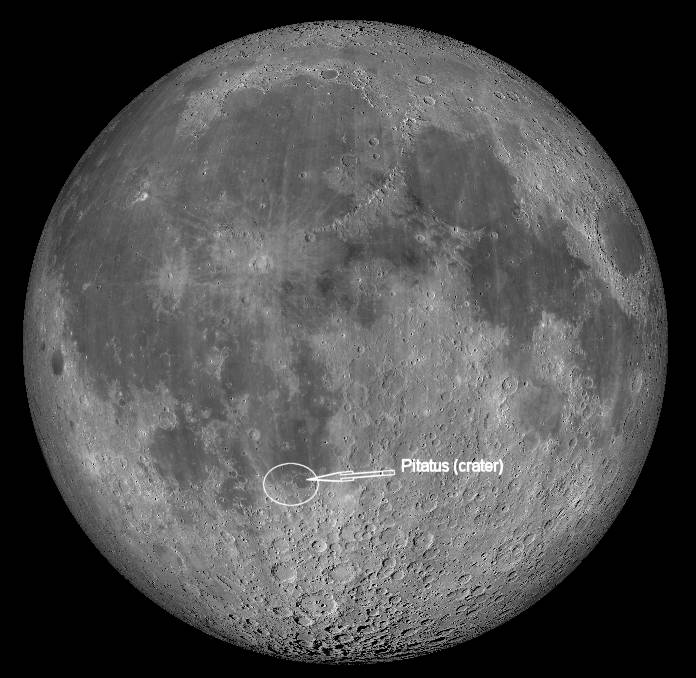
One of the web sites I often check is call SpaceWeather.com. In their January 29th entry, they had a picture of a “concentric crater”, something I had never heard of before. A (very) little looking around the internet reveled a list of about 60 possible such craters, as well as the current theory of their formation, and it's not what you would first think. Apparently, the initial crater forms the initial bowl shape, then the inner ring is formed from underneath the bottom of the crater from magma pushing up on it creating the inner ring. Or, something like that. At least it isn't from a second, very well aimed meteor! Moving on. I decided to see if I might have accidentally imaged a concentric crater and, lo and behold, I did! It turns out to be in the same area of the moon as the one shown in the Spaceweather article. Very close, actually. So, I'll start with the larger view, thanks to Virtual Moon Atlas, and work our way down to the concentric crater, whose name is HESIODUS A.
 |
| Full moon |
 |
| Area of moon where I found Concentric Crater (as did Spaceweather) |
 |
| My image of same area above taken in 2016 |
 |
| Showing Pitatus Crater for reference to full moon image. |
 |
| Hesiodus A, the concentric crater, enlarged from above image. |
Subscribe to:
Posts (Atom)